
Tuesday, December 24, 2019


Tuesday, November 26, 2019

Monday, October 28, 2019
How Democracies Die
“The drift into authoritarianism doesn’t always set off alarm bells. Citizens are often slow to realize that their democracy is being dismantled even as it happens before their eyes.” Steven Levitsky & Daniel Ziblat - How Democracies Die
Today, the slide from democracy to autocracy happens in small increments, over a period of time. Unlike the coup that ends an elected regime abruptly and, in most cases violently; democracies, in the modern political world are killed slowly by the leaders who are elected to protect that very system which they used to get to power in the first place. This, is the premise of the book “How Democracies Die”
 Steven Levitsky and Daniel Ziblatt are Harvard University’s political scientists and this book by them comes at a time, when democracies across the world are being threatened by right wing alpha male leaders. The book is a warning, an alarm, to the ascension of demagogues and helps to identify the preceding signs. Although the book focuses on the US (the idea of the book is prompted by the election of Trump) it uses case studies of leaders from other countries including Putin in Russia, Erdoğan in Turkey, Orbán in Hungary and Maduro in Venezuela. Based on these studies, the authors outline four key indicators, or warning signs, of authoritarian behavior that is detrimental to democracy (1) the rejection, in words or action, of the democratic rules of the game, (2) the denial of the legitimacy of political opponents, (3) toleration or encouragement of violence, and (4) a willingness to curtail civil liberties of opponents, including the media. If we consider these key indicators, there is no denying the fact that Democracies across the world are facing existential threats from big, loud mouthed and divisive nationalist leaders.
In addition to the 4 indicators, the authors also identify two crucial informal norms (the unspoken/unwritten rules) as the pillars of democracy (other than the formal institutions and processes), (1) mutual toleration and (2) institutional forbearance. These informal norms are also being undermined in the recent times, when leaders are focusing on their short-term gains as against the long-term benefits for the nation/people they govern.
The book could have had an increased focus on influence of social media in the democratic process. We have seen in the recent elections of US and India that social media has played a significant role in swaying the though process of voters and thereby the votes and results. Social media (ab)use had a similar effect on the Brexit vote too. We also have most of the leaders today communicating through this medium rather than the traditional media. At times it feels like the US is governed through a series of Twitter posts.
The solutions provided in the book are primarily through lessons from history, which may or may not be applicable in today's world. The solutions also sound too idealistic in the current environment. Nevertheless, this is an interesting and important book which has come out at an appropriate time, especially for us. While we are not seeing all the 4 indicators consistently, there surely are green shoots here and there. As for the 2 informal norms (mutual toleration and institutional forbearance), I am sure the evidence is there for everyone to see (esp., if you watch the 9:00 P.M. special debates). The book is even more important now, considering that there is no visible or audible political opposition today in this country – which, for me, is the first sign of the slide in a democracy.
Sunday, September 29, 2019
Life of the Purposefully Unrushed

A Gentleman in Moscow is an exquisite tale, that for most parts moves like a stream, at a languid pace and then all of a sudden takes a surprising turn and crashes down with the power and beauty of a mighty falls.
Post the Russian Revolution, Count Alexander Ilyich Rostov is condemned to lifelong house arrest in the majestic Hotel Metropol in Central Moscow by a Bolshevik tribunal. He would be shot if he ever steps out of the hotel. And so the story goes on as Count Rostov moves to a disused servant’s quarters (more of an attic) in the hotel and becomes, from an aristocrat, to a waiter and stays on for 32 years, till he makes a stunning escape.
In those 32 years we travel through the turbulent times of Russia, from the Bolshevik upheaval, to the tyrannical times of Stalin (to think that one of our political leaders is named after this dictator who condemned and killed millions of his own folk!) and to Second World War.
For the generation (at least for Sree and me) who grew up on NCBH (New Century Book House on Mount Road, Chennai, was a beautiful place filled with the fragrance of new books, that had amazing illustrations and top notch print and paper quality), Maxim Gorky’s Mother and the romanticism of communism; would be able to connect, reminisce and eventually be disappointed with the reality of the times gone by (there is a remark on Gorky in the book, which would shake those who revered Gorky and The Mother).
The Novel, is a series of lessons on culture, and Gentlemanness (I know it is not a word, but it does sounds appropriate) during some very difficult times), with references to fine wine, books and music (the three core elements of a good life, wouldn’t you agree?). The book is a discourse on moral discipline, but done with a light humor and charm that it hardly sounds preachy at any time (also, there is an awesome reference to Casablanca that is beautifully appropriate).
Narrated in third person, you become a part of the ensemble and grow alongside the characters. Some of them so wonderful, you make friends with them, you hate- just the one character and surely will fall in love with a few.
This is just the second novel for American author Amor Towles ( the first being Rules of Civility, also a best seller). Towles, left behind a successful investment profession of 22 years to become a successful novelist. It took more than 3 years for Towles to finish The Gentleman in Moscow and every page is a testament to that spectacular effort.
Quotes from the book, that I liked most:
- If a man does not master his circumstances then he is bound to be mastered by them.
- What matters in life is not whether we receive a round of applause; what matters is whether we have the courage to venture forth despite the uncertainty of acclaim.
- If patience wasn’t so easily tested, then it would hardly be a virtue
- To what end, he wondered, had the Divine created the stars in heaven to fill a man with feelings of inspiration one day and insignificance the next?
- Life does not proceed by leaps and bounds. It unfolds. At any given moment, it is the manifestation of a thousand transitions. Our faculties wax and wane, our experiences accumulate and our opinions evolve--if not glacially, then at least gradually. Such that the events of an average day are as likely to transform who we are as a pinch of pepper is to transform a stew.
Sunday, September 02, 2012
Bombay Jayashri
 I have no Music knowledge. Can't identify the Ragas like Venkat and don't know the difference between the thalams. In fact there is a complete ban on my singing at home, apparently my singing does not sit in sur(am), don't know what that means either!
But, what I know is that I Love Music, almost of all kinds (except Rap and the technosounds that are unfortunately being bandied as Music). Like most of you, some song keeps going on inside my head all the time.
Bombay Jayashri is one of my favorite singers, I have tons of her songs (thanks to Visu for some of those CDs) and she keeps us company when we have this torturous travel to and from office, fidgeting inside the metal cage. I simple love her dark and husky voice, which is very different from most of the classical singers (which is fairly exploited by Harris Jayaraj and co). At the same time she easily scales those highs too, with the clarity and crispness of the winter breeze. There is a soothing, soul stirring quality to her voice. Listen to her sing Ehi Murare or Katyayini and you will understand what I mean (btw, the complete Salokyam album is outstanding and so meditative).
So, when my friend Prashant informed about a Bombay Jayashri concert and offered the tickets, I was ecstatic, to put it mildly.
We left early to hold on to the best seats, up close and bang in front. I could literally see the whites of the artists' eyes. The hall was very basic, but it did not seem to bother the singer or the fans. The program was scheduled to start at 5:15 and it did start precisely at 5:15 and for the next 3 hours we (the Rasikas!) were transported to a different world. A magical world that was full of joy, spirituality and wholesome goodness. During the entire duration, she did not say a word (except for some polite conversations with the accompanying musicians); she did not pause to take a sip of water. She just came, sang, conquered and left.
Pictures here are some that I managed to sneak during the program - the light was not very good and I was nervous, to be sitting just in front and shooting with a camera (even if I was really careful not to disturb).
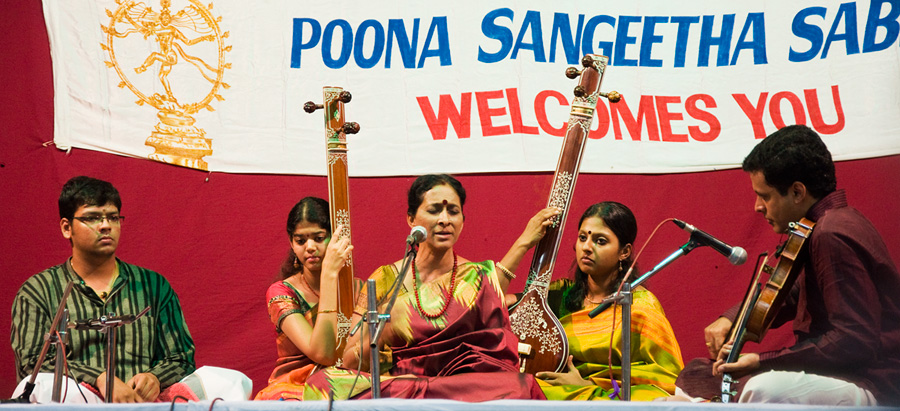


Saturday, February 18, 2012
The Fight
There is savagery
in their bloodshot eyes.
Dilated to see it all,
In those eyes you search for fear.
They go around each other
One waiting for the other.
Waiting to kill,
It’s a fight to finish.
As the volcano erupts,
You see blood on their hands.
Is it the other man’s blood?
Or, his own? You’ll never know.
This urge to succeed
The lust for power
The power that grabs you
Like quick sand.
It’s a search of glory
The glory that’s brought by gory.
This is a battlefield
We mindlessly walk through.
We prepare
To give everything
Including our last breath
For that gloomy Nothing.
Sitting around in the arena
With great delight
We watch, as the Romans did.
We haven’t changed much.
The cry of the dying man
Suppressed by the howl of the survivor.
Sounds stained by blood.
This is our history.
He now waits to take another
And so it goes on
Until everyone is taken,
And till the last one falls.
Friday, October 28, 2011
Jagjit Singh
 I had a great collection of Jagjit Singh's ghazals during my college years and used to hear his songs regularly. Especially, on the morning of an exam day, I would have his songs plugged on to my ears (good old sharp walk man - with auto reverse!). His voice had a soothing effect and I found/find it very meditative. A percentage of my good(!) final year marks can be attributed to Jagjit Singh.
His voice is so heavy and beautiful, just listen to this later day beauty from Sarfarosh… http://www.youtube.com/watch?v=JAh4bqBUGkY (even if you don’t understand the meaning it is fine. May I suggest that you get, if possible, a CD or the mp3 and listen in a good system with the volume a bit higher than normal to feel the heaviness of his voice, the humming portions are so magical.
The lyrics… most of the ghazals are in urdu and are inherently beautiful. This song in Sarfarosh talks about the magic of love and goes something like this (to the best of my borrowed knowledge):
Hoshwalon Ko Khabar Kya
Bekhudi Kya Cheez Hai
Ishq Ki Jaye Phir Samajhiye
Zindagi Kya Cheez Hai
Person who is in his full sense will never know
how it feels to lose oneself (to love).
Fall in love and you will understand
What life is all about.
Irshaad comments that most of the Ghazals are about love or wine... It is true, while most of the songs are about the Nasha of Love or wine (they sure know what to celebrate), many songs are quite philosophical and about some fundamental questions too.
Jagjit Singh passed away this October 10th.
Saturday, July 09, 2011
The Palace of Illusions
 The Palace of Illusions is Mahabharata told from Draupadi's perspective; she is the Protagonist. Given this premise and given that the Mahabharata is the most complex story ever told (wiki: With about one hundred thousand verses, long prose passages, or about 1.8 million words in total, the Mahabharata is roughly ten times the length of the Iliad and Odyssey combined, or about four times the length of the Ramayana), this could have been a magnum opus by Chitra Banerjee Divakaruni (CBD). Unfortunately CBD falters after a great start.
The initial phase of Draupadi's tale, her interactions with her brother Diru and friend Krishna, are told with great sensitivity and style. As Draupadi grows up and gets married, she sounds more and more like an ordinary human (with 5 husbands, of course). Much worse is that Draupadi keeps cribbing (I agree that she had many reasons to crib) and page after page yearns for the forbidden love of Karna. Although these feelings towards Karna (and vice versa) are hinted in other versions of the Mahabharata; the palace of illusions talks about it in almost every page, which kind of gets annoying – ‘for heaven's sake, the human race as we know is getting erased and millions are getting killed in the great war and here we are crying over love’, is what you want to say.
The other disappointment is the characterization of Kunti and Yudhisthir; both are portrayed as one-dimensional cardboard characters and in fact Draupadi treats them with disdain throughout. There is a bit of remorse in the end, but that is probably too little too late. The mother in law - daughter in law interactions between Draupadi and Kunti are so clichéd and you wonder, if the author wants to portray Draupadi as a stong and extraordinary women, born to rewrite history, then why does Draupadi get into these petty trappings?
The good aspects are: the book keeps a good pace, the narrative is easy and does not have the usual complications of a tale of this complexity (probably because the book is targeted at the western reader, CBD lives in the US), yet it covers most of the critical happenings of Mahabharata - with a few liberties taken here and there, like the two marriages and nine sons of Karna are never revealed, probably to keep the romantic angle alive.
For me, the highlight of the book is the Krishna - Draupadi relationship, it touches a few philosophical notes of man-god relationship.
Sample this:
When asked by Draupadi: "Can't you ever be serious?' Krishna replies: 'It's difficult, there's so little in life that's worth it’.
In the end when Draupadi is about to die, Krishna explains the futility of her remorse and tells her that she is just an instrument, this is probably taken from the essence of the Gita itself, but it is a good discussion.
If there is a God, I wish he is like Krishna, ever playful, ever intriguing, great philosopher and charioteer for the righteous (and in the process bends the rules here and there).
Saturday, June 25, 2011
Wisdom Paradox
 This post was trigged by a coincidence; I got a mail from Venkat about this blog while I was reading ‘The Wisdom Paradox’ by Elkhonon Goldberg; the coincidence is that the blog and book are on a similar theme – Dementia or the atrophy of the brain. It is a known fact that our brain atrophies as we age and eventually most of us will lose some and an unfortunate few will lose most of our cognitive abilities. This topic is of great interest to me since I have recently crossed the milestone 4 decades of existence and every now and then I worry about the possibility of me spending the last years of my existence wearing a bib and trying to recollect what I did a minute ago!
The book; The Wisdom Paradox is a paradox in the sense that it gives you hope and at the same time it reconfirms your fears about aging too. The bad news first -after the initial stages of development and maturity (till your thirties) our brain starts to degenerate, starting with the newly evolved neocortex that make us who we are, humans (neocortex controls the working memory, speech and language) and the right hemisphere deteriorates more than the left. So you will have issues with new learning, analytical ability and creativity. Your ability to learn new languages will be affected too (there goes my goal of learning French this year).
The good news is that what you lose in creativity and novelty you gain in wisdom. Wisdom is an acquired response to recognized patterns. So during the early stages of our life we assimilate new information and develop neural patterns. As we age, the brain begins to atrophy, losing about 2% of its size per decade, but we reach insightful conclusions intuitively based on the lifelong collection of the neural patterns. This, you see, is the strength of leadership. The experience accrued over a lifetime being used in decision making, esp in abstract situations – like running a nation or an organization.
The point to reflect is that this wisdom can’t dawn overnight when we become old, we need to collect various experiences in our early stages of life and build the neural patterns that would help in achieving this wisdom, even when as we lose our analytical and learning abilities. So, spend your early years hunting for knowledge (like reading this blog :)) that can be turned into wisdom later.
The Blog; I believe that the overall, degeneration (cells dying as we age) would be of little consequence – so it does not matter that, ‘You had more brain cells the day you were born than you’ll ever have again’. You definitely had less brains when you were born than you’ll ever have. Also, it is very complex, elephants have double the neurons as humans, and if you are talking about the brain to body ratio, then birds have a better ratio… I am sure you will agree that we have better cognitive capabilities compared to elephants and birds (of course, can’t say that for everyone I work with). So, it is difficult to say why you will lose your mind -whenever that happens; but you can be sure that it is just not because of reduced cells. It is worthwhile to note that research has not established the reason or medication for, say, Alzheimer more than 100 years since Dr. Alzheimer described it first. So I find this article to be assuming too many things and making it simplistic. It is possible that dementia is more of genetic in nature and probably has no cure or prevention. And your cognitive skills at the ninth decade would probably be thanks to the strong genes provided by your parents (and generations before them).
I agree that the brain needs constant stimulation (not the one provided by TV) that allows the neurons to form new connections. We should constantly try to learn new skills, improve your social interactions and broaden our knowledge (browsing the net does not count) and ponder about them (hence, having a mid-life crisis is probably a good thing for your brain).
Yes, every time I search for that wretched remote or the car keys; I am worried that very soon I may forget my own name, I am still not sure how to avoid it completely – let me try Sudoku or Rubik’s Cube or learn to draw and paint.
Sunday, December 12, 2010
RX100
 "The real cycle you're working on is a cycle called yourself."
 "In a car you're always in a compartment, and because you're used to it you don't realize that through that car window everything you see is just more TV. You're a passive observer and it is all moving by you boringly in a frame.
On a cycle the frame is gone. You're completely in contact with it all. You're in the scene, not just watching it anymore, and the sense of presence is overwhelming."
— Robert M. Pirsig (Zen and the Art of Motorcycle Maintenance: An Inquiry Into Values)
When you move around in a car with all the windows closed, there are only 2 vehicle exhaust sounds that you would distinctly hear inside the cabin -one is, of course, the Bullet and the other is a Yamaha RX100. The sound is so apparent that my normally vehicle/gadget illiterate dear wife would stir and ask me, ‘That is a Yamaha, right?’ of course she is right (isn’t she always right?), for the heartbeat of an RX100 is very hard to miss. Whenever I hear that sound, I immediately go back by some 20 years, when I had the pleasure of driving around my very own RX100 -a black RX100 (I had to choose and would not take any other bike or any other color).
The day I took my RX100 to college, I became ‘somebody’. Guys I have never known before wanted to be friends with me; I became a sort of mini celebrity (yes, I am exaggerating a bit, but not much). But, one still has to capitalize on this newly acquired status, and I realized this couple of years later when a colleague, exclaimed, “I never thought YOU will be driving THIS!!!” A good way of thanking someone who offered a lift, in the middle of the night!
I took great pride and took great care of my RX100. Used to wash it and shine the chrome every day. Will be tuning and adjusting the idling or scraping the carbon off the spark plug. If I had to sit somewhere I would normally put my bike on centre-stand and sit on my Rx100. I took it to the best mechanic in town, who specializes in Yamaha and also someone who loves bikes (the second attribute was every important). Today, I sometimes wonder where that passion has gone; it is true that I am quite detached when it comes to my car and view it as just a mode of transportation. I am reminded of the quote I read somewhere, “Four wheels move the body. Two wheels move the soul”; that probably explains!
Recently I had the opportunity to drive my old RX100 (I can’t say ‘my’ as it is currently owned by a cousin, who was kind enough to let me drive for a while – of course with a thumping heart I am sure), the old bugger was as good as it was 20 years ago. Obviously between the two of us the RX100 had aged more gracefully! They don’t make bikes like this anymore!
There are many memories associated with this bike (with great reluctance I call it with a lack of identity –Bike). I vividly remember the day I took my wife (then fiancée) out for the first time and it was on this very vahana. We went around from Nungambakkam to Greams Road and the bends around the crooked College Road is still fresh in our collective memory.
A quick anecdote to end this blog; one of those days when zipping down the Bannerghatta road at Blore, my best friend (Happy Birthday, Irshaad ) was sitting behind, tears streaming, he hollered, “I don’t know how you are driving, I can hardly open my eyes!”, and I hollered back, “close them, just as I have closed mine!!!”....
Cheers to those many rides.
Sunday, November 14, 2010
Farewell Waltz
 Just completed 'Farewell Waltz' by leading Czech author Milan Kundera. The 'Farewell Waltz' is a dark comedy at the outer layer, but, underneath, is a very poignant, political novel with a touch of magical realism. The original Czech version was published in the early 70’s but was banned during the communist regime for the political undertones in the narration till 1989.
 The story unfolds over five days in a small spa town with 8 contrasting characters and has commentaries on relationship, religion, politics –all with lightness and a searing satire. The end was a bit sudden and sad (although Mr. Kundera does not delve on the sadness) but overall the book was a fine read. This is my first Kundera and surely not going to be the last.
Couple of quotes from the book (all of these are dialogues between the characters):
- 'To come to the conclusion that there is no difference between guilty and the victims is to abandon all hope. And that, my girl, is what is called hell.
-'There isn't a man in this world who isn't capable, with a relatively light heart, of sending a fellow human to his death. At any rate I've never met one. If men one day come to change in this regard, they'll lose a basic human attribute. They'll no longer be men but creatures of another species'.
'You people are wonderful!'... 'When you turn everybody into murderers your own murders stop being crimes and just become an inevitable human attribute'.
Both the quotes are in reference to the political situation in Czech during the 1970s; when uprising and suppression of these uprisings thru capital punishment was a norm. After a while the roles reversed the revolutionaries moved to power and persecution of the earlier rulers started, hence there is a blur of victims and the guilty.
Second quote is a dialogue between 2 characters when they discuss about human nature and how we will punish a fellow being with certain happiness (sadistic pleasure if you will); History is strewn with people who stand testimony to this statement.
And finally the most interesting, “All I know is that I could never say with complete conviction: Man is a wonderful being and I want to reproduce him”. Again, this is a dialogue between 2 characters in the book where one gives out reasons why he will never sire a child! What a powerful reason -I have tried this life, but do not find in good enough that I will recommend for someone else!
Feeling an emptiness that follows the completion of a good book!
Saturday, November 06, 2010
Following Fish by Samanth Subramanian.
 Travel and cooking are 2 of my (many) passions! I just love travelogues. I have already written about Bill Bryson here, the other writer I recently discovered and loved is Paul Theroux. An unexpected but good read was Che Guevara's ‘The Motorcycle Diaries’ - of course that is not just any travelogue.
 Travelogues just take you to distant and mystical lands for a few hundred rupees and you could do the journey by just sitting on your couch and without the travel fatigue.
I picked up 'Following Fish', without any knowledge about the book or the author. I was a bit skeptical, given the drab cover and a fishy title :)! Since it involved both travel and food, I could not resist. To my pleasant surprise, it indeed turned out to be a wonderful read for a weekend.
The book is divided into 9 essays and it starts from Kolkata and its famous Hilsa and rightfully so, as Kolkata is the food capital (at least for seafood and sweets) and Hilsa is the queen of fishes.
The journey takes a detour inland to Hyderabad where Samanth visits the Goud's family for the famous fish treatment for his Asthma and returns skeptical than before.
The best part of the book is the essay in search of the best toddy and karimeen in Kerala and the one about the Mangalore fish curry comes a close second. The journey continues to Goa (of course), Mumbai and ends at Gujarat. Befittingly, for Gujarat, the last essay talks about the huge fishing boat building industry rather than the cuisine.
The writing is easy and almost like a note from a friend and lyrical at times and sparkling with humor all the time. The author draws in from a host of other great writers and sprinkles their quotes throughout the book. The essays are full of colorful characters and their interesting stories - this is the book's greatest strength.
The book also touches upon the cultural, ecological issues of the day, talks about the dwindling fishes in our seas, and the sandless beaches of Goa, where the tourist industry is eating into the fishing industry. 'Goa - A state that had come to be unfortunately infected with the idleness of its guests'.
This is Samanth’s first book and I hope he continues to write in this fashion for a long time. May he continue to be the 'discoverer of people, a finder-out of stories'.
Sunday, October 24, 2010
Iconoclast - Gregory Berns
 The dictionary (http://www.thefreedictionary.com) definition of an Iconoclast:
iconoclast [aɪˈkɒnəˌklæst]
n
1. a person who attacks established or traditional concepts, principles, laws, etc.
But the general understanding from this book (at least for me) is that an iconoclast is someone who breaks through barriers (both internal and external) and sells his Idea to make an impact on the society (for the betterment of the society) and, of course, makes some money and success in the bargain!
Gregory Berns is a leading Neuroeconomist and the Distinguished Chair of Neuroeconomics at Emory University, where he is a professor in the department of Psychiatry and Economics! In this latest book, 'Iconoclast', Mr. Berns explains an iconoclast's ability to think outside the box (I tried to avoid this cliché) through the brain's biological functions and tells us how to harness these powers -including an appendix (Iconoclast's Pharmacopeia) on drugs that can enhance the iconoclastic powers! – this appendix, I specially found to be very interesting!
What makes this book even more interesting is that, Mr. Berns connects these theories to the many real life iconoclasts (including Florence Nightingale, Jackie Robinson, the Dixie Chicks, Pablo Picasso, Richard Feynman and Steve Jobs) and provides valuable insights around the central theme of the book.
Many books are termed as life changing (probably for the author :) ) and this is such a book. According to Mr. Berns; an iconoclast has three traits that differentiate them from the others:
1. Will view things differently - perception
2. Overcome their fear of failure - Fear factor
3. Have great social skills - Network
View things differently: Brain runs on very little power (around 40 watts -if you must know) and hence will conserve power wherever possible. In the process of this conservation, our brain uses perception gained from experiences to form ideas; so to think differently (like an icon) we need to avoid these brain shortcuts and bombard the brain with new information, change in routines and novel experiences.
Overcome the fear factor: Novel experiences stimulate the fear factor in us and we need to overcome this fear to succeed, fear is a major success inhibitor. The author describes options to overcome (rewire the brain) this stress, by accepting (preconditioning), by avoiding unpleasant associations (blocking) and by developing a don’t care attitude (develop a thick skin). Even a short physical stress (exercise) can be used to overcome long term mental stress.
Learn to network: Developing and nurturing good ideas is not sufficient, one must sell these ideas to others and this can be achieved through strong networking skills (Picasso Vs van Gogh). One has to build a social network with the realization that the brain works in a 'tit for tat' basis (a good deed will be reciprocated), maintain a good reputation and constantly being in touch with the social network (breed familiarity).
This is it… three traits that can make you an icon. Are there only these 3 differences between an iconoclast and an aspirant? I don't think so, but these are some good starting points for the Icon to be!
The book drags a bit in the middle, but as mentioned earlier, the relative stories from the lives of icons makes it interesting and keeps us going (including Dixie Chicks as one of icons was stretching it a bit far).
Some good quotes from the book:
-Perception is a process that is learned through experience, which is both a curse and an opportunity for change. P. 8
-Unfamiliarity forces the brain to discard its usual categories of perception and create new ones. P. 33
-The more radical and novel the change, the greater the likelihood of new insights being generated. To think like an iconoclast, you need novel experiences. P. 57-58.
-The critical fears that inhibit people from sharing their ideas: the fear of being rejected. At its core, this fear has its origin in social pressure, which is one of the most common of human phobias. Pp.77-78
-Groups that allow for minority opinions are statistically more likely to make better decisions than groups that require unanimity. P.103
-A group with a lot of diversity among its members is more likely to arrive at a good decision than a group that is composed of members who are alike. P.104.
-The brain is lazy. It changes only when it has to. And the conditions that consistently force the brain to rewire itself are when it confronts something novel. Novelty equals learning, and learning means physical rewiring of the brain. P. 199.
Saturday, August 21, 2010
Bill Bryson
 My wife calls me the most boring person in his 30s (very late 30s), for, it is not very often that I break into a laughter or even a smile. It is not an exaggeration to say that I am emotionally as flat as a warm beer. So, whenever she sees me chuckle she orders a cake to celebrate and these celebrations happen very often when I am reading a book by Bill Bryson.
Bill Bryson was born in Des Moines, Iowa (1951), spent most of his professional life (as a Journalist) in the UK, moved back to US very briefly and moved again to England. In the process he wrote two wonderful books: 'Notes from a Small Island', a travelogue across 'United Kingdom', just before moving back to US and 'I am a Stranger Here Myself' - a compilation of his weekly column on the changes that have happened to the US in his absence. Today, he is probably the best selling non-fictional author, surely the most loved. It is not an exaggeration when Chicago Sun-Times says that, "Bill Bryson could write an essay about dryer lint or fever reducers and still make us laugh out loud."
I got introduced to Bill Bryson on the 21st of July 2004, when i brought his popular science book "A Short History of Nearly Everything", in a small, excuse for a book shop at the Pune airport (finally, some use of noting down the date and place of purchase of a book!). 'The Short History of Nearly Everthing' is a wonderful compilation of, as the title suggests, a short history of nearly everything, right from the big bang, thru the early stages of our planet, evolution, and an impressive cover of various developments in science. All of which is told in an engaging, dry 'Bryson' humor.

It all starts from an admission that he is not familiar with science and how science books at school were a bore (they still are!) and one fine day in a trans Atlantic flight he was struck by the realization of how little he knew and became curious to know more; how lucky for us! This book must be a mandatory study at every high school! The book really shows us how little we know of the planet we call home and even about ourselves. It is a huge seller internationally and won the Aventis Prize for Science Books as well as the Descartes Science Communication Prize.
After finishing this book, I hunted for all the other books written by Mr. Bryson have managed to read whatever is available in the market! All of them written with the same great wit and a style that is so endearing.
BTW, I have just got home his latest book 'At Home" and my dear wife is ordering for cakes!
Here is a sample chapter from his book "I'm a Stranger Here Myself" -an absolute joy.
His other books:
The Life and Times of the Thunderbolt Kid
Bryson's Dictionary of Troublesome Words
Bill Bryson's African Diary
In a Sunburned Country - Travel - Australia
I'm a Stranger Here Myself
A Walk in the Woods
The Lost Continent: Travels in Small-Town America (1989)
Neither Here Nor There: Travels in Europe (1991)
Notes from a Small Island (1995)
Made in America: An Informal History of the English Language in the United States (1998)
Shakespeare: The World as Stage (2007)
And the latest:
At Home: A Short History of Private Life (2010)
Wednesday, April 07, 2010
King Corn - Documentary

Couple of days back, I had a chance to watch the documentary, King Corn thru NetFlix “watch instantly” option. BTW – this worked very well. There was no disturbance/buffering when I watched it; it also “remembers" where I left when I resumed viewing in a different machine.
This movie is produced by 2 college grads – Ian Cheney and Curtis Ellis - alarmed by the obesity epidemic and ubiquitous presence of corn in almost all processed foods, they move from Boston, MA to Greene, Iowa to grow and farm an acre of corn. During this period, they try to trace the corn from fields to the food system and come across many troubling questions about how and what we eat.
Though the farming aspect of the film is slightly boring, the film makers have captured the viewer’s interest by graphically presenting the data on where the “manufactured” corn goes – to sweetener industry for High fructose corn syrup, to feed lots for cows and chickens for fattening etc. America has moved from small farm owners to big corporation thanks to the technology improvement in farming practices. For example, the movie shows/says that an acre of land takes about just 18 minutes to plant corn seeds. Corn yield per acre in 1970 was 86 Bushels whereas in 2007 - 180. Technological improvements in the farm yield, is direct result of farm subsidies (introduced thru the farm bill (1973) by Earl Butz) which makes farming corn a profitable one. This farm bill was instrumental in making the food cheaper and resulting in more disposable income available to amercian families.
If you take McDonald's meal, you don't realize it when you eat it, but you're eating corn. Beef has been corn-fed, Soda is corn. Even the French fries. Half of the calories in the French fries come from the fat they're fried in, which is liable to be either corn or soy oil. Everything in your plate is corn. - Michael Pollan, UC Berkeley, in King Corn
The upside of the farm bill is - food became cheaper and made americans to spend just 10% of their income on food in 2009 (from 22% in 1949) - one of the lowest in the world. Industrialization of food also made food available throughout the year. Politically, a noble and a electorally powerful goal too.
The reductions in cost and year round availability of food - took its toll on human health. All animals (cows, pigs, chickens) are made to eat just corn, because corn is made cheaper thru subsidies. These animals are not evolved to eat grains 100% (including humans, of course, but that is for a different day).
To quote from natural news on the effects of forced grain feeding for animals, "Ruminant cattle, like cows and sheep, possess a special digestive system in which grasses are converted into digestible nutrients. Unlike humans who are unable to properly assimilate grasses and their nutrients, these animals are able to convert the plant cellulose into protein and fats. The result is a meat composition of roughly a 1:1 ratio of omega-3 to omega-6 fatty acids with omega-3 dominating slightly.
Grains, disturbs the cow's digestive system that, unless done gradually, can kill the animal. "Feedlot bloat", a term used to describe the buildup of trapped gas in the rumen of the animal, is the primary reason why feedlot cattle must be fed antibiotics and hormones in order to keep them alive. Their digestive systems are unable to process the immense amounts of starch in their feed, turning their pH from neutral to acid and causing them to contract a myriad of diseases".
The health impact for humans are also discussed in the movie; Whether the corn gets to sweetener industry for High Fructose Corn Syrup or it gets to the cows/chicken/pigs as food – everything comes to us in the form of milk/yogurt/jelly/soda/bread/meat – what we consume. And it changes the human metabolism considerably causing life style diseases including Type II Diabetes and heart disease.
All in all, worth watching documentary and take an informed decision on what to consume.
Friday, April 02, 2010
Pink Floyd

I am not a great fan of Pink Floyd. Yes, like everyone who grew up in the 80s, I have listened to the Another Brick in the Wall and loved the video and applauded what the song and video stood for. Otherwise I go for something that is a bit on the milder side.
Recently, fortunately, came across a couple of songs from Pink Floyd and the lyrics just blew my mind away. The band is known for its great lyrics and like any great art form, the interpretation is usually left to us.
For me, these lines are biographical, my biography! Probably, yours too! When I was young, just wasted all the time waiting for someone to show me the way and now I am always chasing something or the other, in the meanwhile Time is just slipping away.
Ticking away the moments that make up a dull day
You fritter and waste the hours in an offhand way
Kicking around on a piece of ground in your home town
Waiting for someone or something to show you the way
Tired of lying in the sunshine
Staying home to watch the rain
And you are young and life is long
And there is time to kill today
And then one day you find
Ten years have got behind you
No one told you when to run
You missed the starting gun
And you run, and you run to catch up with the sun, but it's sinking
Racing around to come up behind you again
The sun is the same in a relative way, but you're older
Shorter of breath and one day closer to death
Every year is getting shorter
Never seem to find the time
Plans that either come to nought
Or half a page of scribbled lines
Hanging on in quiet desparation is the English way
The time is gone
The song is over
You fritter and waste the hours in an offhand way
Kicking around on a piece of ground in your home town
Waiting for someone or something to show you the way
Tired of lying in the sunshine
Staying home to watch the rain
And you are young and life is long
And there is time to kill today
And then one day you find
Ten years have got behind you
No one told you when to run
You missed the starting gun
And you run, and you run to catch up with the sun, but it's sinking
Racing around to come up behind you again
The sun is the same in a relative way, but you're older
Shorter of breath and one day closer to death
Every year is getting shorter
Never seem to find the time
Plans that either come to nought
Or half a page of scribbled lines
Hanging on in quiet desparation is the English way
The time is gone
The song is over
This song is said to a tribute to Syd Barrett, one of the original members and a genius, who had a mental breakdown possibly due to heavy drug usage. You can, of course, interpret this in many ways and relate it to your relationship with someone. Wonderful guitar solo.
How I wish, how I wish you were here
We're just two lost souls swimming in a fish bowl
Year after year
Running over the same old ground
What have we found?
The same old fears
Wish you were here
We're just two lost souls swimming in a fish bowl
Year after year
Running over the same old ground
What have we found?
The same old fears
Wish you were here
Tuesday, March 16, 2010
Track your Plaque - Book Review

How often do we come across news wherein a friend or a relative suffered a heart attack and had to die all of a sudden?
Do you know that the conventional tests (HDL, LDL, Triglycerides, Total Cholesterol, Treadmill test) for assessing whether a person has a risk for future heart attack are woefully inadequate? Meaning, even after all the above are performed on time (with results are considered normal range) – still that person can experience a fatal/non fatal heart attack?
Very often we hear that an apparently otherwise healthy individual suffering from heart disease had to undergo bypass surgery or had to operate with stents etc.
If you want to find answers for this and to educate how to protect yourself – you have to read Track your Plaque book. Dr. William Davis addresses heart disease and what causes heart attacks, how we can identify the risk one has against heart disease, how we can improve upon those parameters through life style changes, diet and medicines.
Why this book? Don’t we have hospitals for cardiovascular care and incase if someone has heart disease – he/she can get better treatment in the hospital, why read this book and make changes to life style among other things?
From Dr Davis's own words - Cardiac care is big business. As a nation, US spent $59 billion on cardiovascular care per year (American Heart Association, 2002). Annual hospital revenues for bypass surgery total $25 billion. Thirty percent of hospital revenues and 50% of profits are from cardiac care. Heart care to a hospital is like the Accord is to Honda, or Windows is to Microsoft—it’s a hot seller.
We live in an age when hospitals measure their success by the number of coronary bypass surgeries they perform. Incredibly, it is still easier to get a bypass operation than it is to get good information on heart disease prevention. There are even billboards on the highways advertising bypass surgery.
Second – this book explains that plaque take decades to grow (for most people) in the arteries and by taking right steps and actions at the right time (not when taken to ER) – we can successfully regress it. This is not big money to you or for the hospital. You can achieve this at much lesser cost than a bypass or an operation involving stents etc. So hospitals are not going to be advertising preventative things to you and me over TV and media. There is no money for them in this. It is your responsibility to protect yourself.
This book explains that - non-invasive 10 min scanning of the arteries for calcium deposits using an Electron Beam Tomography (EBT) Scanner. Based on the scan results, the cardiologist will assign a risk score to the patient, and will order additional blood tests least of which is LDL, HDL, triglycerides and Total cholesterol. Not that they are not important. There are more “definitive” tests that can/need to be done today and identify our current state of Cardio parameters rather than relying on the same old LDL, HDL and triglycerides. A good result in LDL, HDL test does not mean that one is not going to have heart attack.
Based on those results – the patient can work with the Doctor and identify what needs to be done for improving the odds.
One thing I wanted to mention – in the changes that need to be done to improve health - food/fats – the Dr and the author Dr. William Davis argues against saturated fat. He castigates that saturated fat is unhealthy and is not required for the body. In fact it is just the opposite. Second he also says you can consume Canola oil which I do not agree. Vegetable oils (Corn oil, cottonseed, rapeseed etc) are a menace and humans are not evolved to consume that in industrial quantities, which we do . Third he also mentioned that Oat bran can be consumed – I am against it. Oats raise blood sugar and it cannot be good for anyone’s health including Cardio parameters. Recently William Davis wrote in his blog that he has changed his mind on Oats.
Dr. William Davis also runs a program called Track your Plaque. All of the concepts explained in the book – you can also have it done thru this program.
The key takeaway is - artery plaques can be identified in humans using non-invasive techniques, additional blood tests will need to be done to identify what caused the plaque, adopt life style including medicines, supplements and diet and you can regress the plaque.
A must read for anyone who is interested in staying healthy and not wanting to give a surprise to oneself or family.
Wednesday, January 27, 2010
The Prestige
 Nolan brothers make movies that respect the intelligence of the audience and even challenge the viewers to look beyond the ordinary. I watched 'The Prestige' last week and was thrilled to find that this movie was no exception.
'The Prestige' revolves around the rivalry between two stage magicians during the early 20th century in London. The rivalry turns into obsession for an ultimate illusion and both men pay a heavy price in the bargain. The movie has wonderful twists and turns and will keep the viewer guessing. Even after a week, I am going back to the movie again and again as I recollect the hints the director left here and there.
The movie adopts a typical Nolan brother's non-linear style of story telling and goes back and forth. 'The Prestige' weaves reality in the story, by bringing in the character of Tesla and his legendary struggle with Edison, the rivalry between these two real life giants run parallel (at least for a while), to the rivalry of the reel magicians. (Tesla worked with Edison during his early years as a scientist, but split and worked against him after a bitter fight. Edison was a mean and manipulative scientist; they were fighting for the standardization of current, Edison for DC and Tesla for AC; their fights were legendary. The popularity of AC today proves who won the “current wars”:-))
The cast includes Hugh Jackman and, Christian Bale as Robert Angier and Alfred Borden - the obsessed magicians, and David Bowie as Nikola Tesla. It also stars Michael Caine as Cutter the stage engineer, who designs and manages the illusions from behind the scenes, Scarlett Johansson as the attractive stage assistant, at her seductive best, who falls in love with Borden. Although all the actors have given their best; watch out for Michale Caine as he weaves his magic yet again and proves that he is the master, even at the ripe age of 76.
Watch 'The Prestige' to appreciate the craft of story telling and for Caine's performance and "watch it closely".
Read Toto's review here
Saturday, January 02, 2010
Black Swan
 I was watching this program on a business channel last week (I rarely commit such a sin, but it was one of those days) the program was on: "How markets will behave in 2010", with great dismay I watch an expert talk (with great authority) that the market will cross 20k in 2010. The market will need a lot of Bull (pun intended) to cross 20k, the man was doing his bit. I am sure you have the same feeling of dismay while you switch to one of those news channels and hear the pundits predict a poll outcome.
I have seen the head of sales and marketing of my company make a series of calls to his contacts at critical client organizations and conclude and report back that we are not going to be severely affected by the slowdown, of course he was wrong, we were not spared and neither were our clients (this was in 2000 - 01). We have seen this happen over and over again, especially in the current globalized economy, Chaos Theory rules. A butterfly flap in New York will crash (or push up) the markets in Tokyo. We have seen many predictions and decisions based on past data/experience going awry in business and in our day to day life. This is the theme of Black Swan, a multimillion copy seller by Nassim Nicholas Taleb.
Nassim Nicholas Taleb is an extremely complex character, he is the grandson and great grandson of former deputy prime ministers of Lebanon (his grandfather and his great grandfather were both deputy prime ministers of Lebanon), he is a mathematician who prefers to call himself a philosopher, had a short career as a trader and investment banker in many leading banks (although, he is very skeptical about the many models used for trading). Later he
 started Empirica a hedge fund that trades in options and then retired from trading in 2004 (he continues to be an adviser for Empirica) and incidentally Empirica made a few billions during the recent market crash. He is a distinguished professor and of course he is the author of hugely successful books, Fooled by Randomness and later Black Swan. He has sold more than 2.7 million copies in some 31 languages. He never watches television and never reads newspaper! Hope I covered the many facets of Taleb. Here is a write up by Malcolm Gladwell on Taleb (this write up is also a part of the new book by Gladwell titled "What the Dog Saw").
Taleb strongly believes (and I would agree) that we lack the ability to predict events that are rare but have great impact, he states that there is no difference between the person in a position of power ( A deputy prime minister of Lebanon) and his car driver when it comes to knowing the way events are going to play out. Both believed that the Lebanon war would end soon, but it took 15 years when you look at most of our ministers you would readily agree. The difference is that the qualified think that they have some privileged info and the unqualified does not think so and puts the burden on fate/God.
Taleb talks about Inductive Reasoning and why it will fail, the title of the book is a good example of inductive reasoning. Let me explain, since people in Europe had never seen a black swan, they thought all swans were white. In fact there used to be a terms about Black Swans that people used when they wanted to refer something improbable (I would rather see a black swan before I see you coming on time!) and the sighting of a single black swan in Australia blew away the belief held for centuries. Inductive reasoning is generalization, we tend to generalize with specific set of (past) data and when this generalization proves to be wrong, it is often with disastrous results. Mike Gatting had seen many spinners before and Australia is not a country that has produced decent spinners in the past (Rajan to confirm). He would have thought that this is yet another bloke from down under and this first Warne delivery against England (known as the Ball of the Century or the Gatting Ball) was a complete Black Swan, the look on Gatting’s face was priceless.
Black Swans can bring good fortune too; the explosion of IT in India is a Black Swan - at least for the many graduates who passed out after 1991.
Black Swan events are random, hard to predict and rare events that create high-impact (Outliers). Taleb, defines black swans as below:
1. Hard to predict (based on historical information)
2. Has disastrous effect
3. Explained after the occurrence of the event by experts.
This has not been an easy book for me... but it is entertaining never the less and been an information overload and introduced many useful terms for sure : platonicity, narrative fallacy, modernistan, falsifiability; to name a few). I found the style to be contentions, probably a bit too aggressive and egoistic. The (repeated) digs he has at the cost of many economists and statisticians are at times in poor taste, so are his digs at the French.
Taleb also gives 10 points/principles to a Black Swan proof world, can be read here with description. Giving below some that I liked a lot:
- No socialization of losses and privatization of gains.
- People who were driving a school bus blindfolded (and crashed it) should never be given a new bus.
- Counter-balance complexity with simplicity.
- Do not give children sticks of dynamite, even if they come with a warning .
- Only Ponzi schemes should depend on confidence. Governments should never need to “restore confidence”.
Try this (from the book):
All Snoogles are Boogles.
You see a Boogle.
Is that a Snoogle?
Spend a minute and you will get it. I tried this on my daughter and explained here the logic and it was an interesting experience, she thought that I had finally gone crazy completely:-)
The answer is 'may be'.
Tuesday, December 29, 2009
Rajiv Kolai Vazhakku - NHM's new book
 Ordered the book online – “Rajiv Kolai Vazhakku” (Rajiv assassination case) authored by Mr Ragothaman – Chief Investigating officer of Special Investigation Team (SIT). Kizhakku Pathippagam has published this book too. (pages 227, Rs 100).
I was interested in this book for 3 reasons. First, this incident happened right around our graduation years where we can understand and analyze (and discuss endlessly!) the social, political situation that lead to this (unlike Mahatma’s where we have to go by books or hearsay), Second this happened right in Tamil Nadu, third being Rajiv was former Indian Premier and had all chances of bouncing back in that elections to power. Other than that I am not a Cong sympathizer and hence do not believe that Rajiv would have ushered in Raama Raajyam.
So, back to book. I received the book one afternoon and started reading it casually. Could not stop in between and completed it in one shot. Wonderfully written book. The author has narrated the investigation process from the beginning till its end.
The book explains step by step how the SIT started with just Haribabu (photographer) camera, his employer Suba Sundaram’s denial that Haribabu was not employed with him, Haribabu’s Mom’s doubtful behavior before the investigation team, his Dad’s body language – conveying that he wanted to share information but holding back because of his wife’s presence etc. From there, the book travels to Baghyanathan (Nalini’s brother), other LTTE functionaries and by implicating Pottu Ammaan and Prabhakaran and finally also explains why SIT team was waiting outside Sivarasan’s hideout in Bangalore with no meaningful action.
The book details the motive behind - why LTTE wanted to kill Rajiv and cites evidence towards that end. And also implies that this is not the work of any other group(s) or individuals.
3 assassinations have happened in India since Independence. Mahatma, Indira and Rajiv. Time has taught that we (Indians) lost Mahatma due to sheer irresponsibility. The powers that be at that time, felt that no one will kill Mahatma and hence the security was very lax and finally we paid the price. The same thing happened in Indira’s case also. The book says that in the senior Intelligence officers meet it was decided to remove all Sikhs who was employed to provide Indira’s security. One of the affected police guy went and cried before R K Dhawan and he rolled back the order. We know the result.
The book talks of ineffective security and a general lax attitude when Rajiv made his last trip. Rajiv flew in from AP that day and his copter was delayed by 2 hours. None of the policemen involved in providing security at Chennai were aware of the delay whereas Sivarasan was aware that Rajiv is arriving late by 2 hours. When CBI enquired with a Sub Inspector (in charge of recording and allowing who is permitted to garland Rajiv) – Inspector had recorded names in a piece of paper he picked from the floor. It did not carry any additional information about people seeking to garland the leader.
Secondly, the author talks of his anxiety in not allowing CBI to investigate the political leaders. Even when CBI had many reasons to suspect that some of the prominent TN leaders had prior information of the assassination, they were not allowed to enquire any of the politicians. The book details the reasons for suspicion and raises many questions in the readers mind.
Thirdly, the coordination between RAW, IB, CBI and Jain Commission etc. The author has explained that instead of working together, these agencies were at loggerheads helping the common enemy. (Apparently, the then RAW chief kept stating, LTTE did not commit this crime and hence that angle should not be probed at all).
On the whole, I agree with the author that we need to know the truth and what happened during those days. For those inclined to know about the Rajiv assassination case, I would recommend to read this book.
Subscribe to:
Posts (Atom)

-
 Like many things in life, I was neither in the front bench nor was I a last bencher in the school, probably because of this; I don't rem...
 -
 Couple of days back, I had a chance to watch the documentary, King Corn thru NetFlix “watch instantly” option. BTW – this worked very well....
 -
 "The real cycle you're working on is a cycle called yourself." "In a car you're always in a compartment, and becaus...