Monday, January 18, 2021

Novelist, Spy and Gentleman


My first brush with John Le Carre happened when, as a kid, I discovered “The Spy Who Came in From the Cold” and “The Looking Glass War”, among the books that my grandfather had left behind. Although I read those books many, many years later, somehow the names have stayed on in my memory and I still remember the red cover page of “The Spy Who Came in From the Cold”

John Le Carre was born, David John Morre Cornwell. His mother left them when he was 5 (he tracked her later- but could not mend the relationship) and his father Ronnie was a notorious conman, who would use David and his elder brother in all his schemes and also beat them up regularly. David never went to a proper school and grew up without love or books. This disturbing childhood left a deep scar (“Until I die the father-son relationship will obsess me”) and would be a recurrent theme in his books in some shade; especially so in the 1996 semi-autobiographical novel ‘A Perfect Spy’.

David had to adopt a pen name as he was a spy himself and worked with MI5 and MI6 and started writing his books while in service. His first book was 'Call of the Dead' in 1961. But it was the ‘The spy who came in from the cold' that turned the limelight on John Le Carre and he resigned from the service (probably asked to leave) and became a full-time writer. His writing was dark and realistic compared to the flamboyant and glamorous world created by the other British spy novelist Ian Fleming (who was also a British intelligence officer). The characters they created were also starkly contrasting; George Smiley and James Bond respectively. Smiley, is a lonely, brooding, (sometimes bumbling) and pudgy (often, he is referred to as a ‘toad’) character who, nevertheless, is a brilliant spy who is devoted to his country and profession.

Among this many books, I especially love the Smiley series but my favorite Le Carre has to be Tinker Tailor Soldier Spy (also made into a successful movie in which a shapeshifting Gary Oldman plays a wonderful Smiley version). In this maze  of a story, Smiley goes about to find the Russian mole inside the agency and becomes the head of the crumbling MI6 the Intelligence agency known internally as the Circus and starts to rebuild it (Le Carre created a delightful set of spy jargons like Circus). The 6 part BBC mini-series “Smiley’s People” where Alex Guinness plays Smiley is riveting too – this is available on YouTube. But that is just me; if you have to read just one of his novels or looking for a book to start, then “The Spy Who Came in From the Cold” is the place to start. This gripping story would raise many moral questions and will question the assumption that West was morally superior (during the cold war era).

Le Carre’s plots are complex and covered by many layers of intrigue; he brought a seriousness to the genre by creating a dark and treacherous world driven by the political interest that was morally ambiguous, especially during and post-cold war era. After the end of the espionage era; Le Carre takes up new villains in the form of corrupt businessmen, arms dealers, terrorists, and even big pharma and continued to write in everlasting righteousness and integrity till the ripe old age of 88 (his last book Agent Running in the Field (2019) is written with Brexit as the backdrop). For all his formidable writing, he notoriously shied away from recognition; he turned down an OBE; withdrew from the Booker nomination, and gave away the Olof Palme prize money to Doctors without Borders. With his passing, a giant who wrote serious fiction, and who wrote that, better than many serious non-fiction writers passed away. Writers come and go; but someone like Le Carre, who creates a genre, rules it for nearly 60 years, and thus influencing a whole generation of authors and creators, they don’t come very often. 


John Le Carre passed away on the 12th of December 2020.

Wednesday, November 25, 2020

A letter from the future (after a 3 year lockdown)


My Dear,


As we complete 3 years of shutting ourselves in, I thought of writing this to you, not because we are apart, but because we may read this on a day in the future when we want to look back at our best during the worst of times.

As home and office blended with each other and as the days and nights blended together, I am happy to be still working, more than working, I am glad I am still alive and that we are still a family, staying intact. I never thought I will miss my commute through these Pune roads, but there it is, I do miss the long journey to the office and back, I miss that bad canteen food, and to my surprise, I miss some people at work too (no, I am not going to name them nor am I going to say why I am surprised). But these are good problems to have, no?

Over these 3 years, we have come closer, we got to know each other better, we support each other in all we do, small and big. Our early thoughts and fear that spending more time alone, just the two of us, would only breed contempt proved to be wrong, rather happily. Of course, we get to see the rest of the world only through a zoom

I do not know how much longer we need to go on like this, do not know when we will have a vaccine or a pill to feel safer, to get out, and go back to what we used to call normal. We are tired of news of a miracle or a miracle medicine and have in fact stopped believing in all such news. We just brace for the lockdowns, one after the other. We shut out all data of the disease and the details of how many died. We just think of, ‘what to cook for dinner’ (with what little we have) or ‘what to watch on NetFlix or Prime’. We just take one small challenge at a time; we just look at each day on its own. After all these years, we have started to live in the present. A Zenish, mindful living; some would call it.

Yes, we have changed in other ways too, mostly for the good, we have learned to be frugal, right from what we eat, and to any other resource we use. We have learned to be thankful for trivial things. We are healthier than ever before.

Still, when I see the photos you have kept on display or when I hear the sound from the conch shell (which I found while cleaning the house), I slip back in time and recall how the waves used to wet our feet again and again, how you used to run those grains of sand through your fingers. Most of all, I yearn to just sit with you, and watch the full moon bathe the Shore Temple and turn the sea to silver… just, one more time.


Love,

K

July 17, 2023.


Ship of Theseus


Friday, June 26, 2020

The Pandemic of Our Minds

“But race is the child of racism, not the father.”
― Ta-Nehisi Coates, Between the World and Me

“So, let’s all get a little uncomfortable.”
― Ijeoma Oluo, So You Want to Talk About Race

The killing of George Floyd by police during an arrest in Minneapolis on May 25 and the (US) nation-wide demonstrations and protests that followed the unfortunate event, kept me thinking about this complex issue of racism and I sought out to read some contemporary writings on the subject. Two books really stood out and came highly recommended; “So, you want to talk about race by Ijeoma Oluo” and “Between the world and me by Ta-Nehisi Coates”.

I especially liked ‘Between the world and me’, which is written in the form of a letter from the author to his 14-year-old son, Samori. The book is an intense account of what it means to grow up and be black in America today. The writing reflects the depth of the author’s fear and anger while he was growing up in West Baltimore. Since Mr. Coates is trained as a poet, the book is structured and written elegantly. At some places, it made me pause and deliberate at the depth of the issue even today, but I reserve my thoughts as I will never be able to fully comprehend the feeling of being a minority and fighting against centuries-old systemic oppression.

Conversations on race and racism can make most of us uncomfortable and it surely is an area of uncertainty for people of all races. Ms. Oluo’s book is a simple and straightforward guide for handling those complex conversations with sensitivity and clarity making this an important book for everyone. Some of the ideas in the book - like the origins of the US police force, the ‘School to prison pipeline’, Model Minority were revealing, especially for a third person to the core topic of this book. Comparatively; this book is an easier read, (but equally powerful), will truly make us uncomfortable, and question some of the interactions we take for granted.
Both the books are mostly specific to the US, but the emotions and ideas expressed are common for all of us, and in that sense, they are profound, enlightening, and searing documentaries of our times.

Reading these books had me thinking about the biases we carry here in India. It is not news that we are one of the worst offenders when it comes to our love for fair skin. The huge market for fairness creams (valued around 4000 Crores. 62% of Indians in the age group of 15-34 are users as per a survey conducted in 2016, 39 % are regular users), the bombardment of the adverts for those creams during primetime (this is despite 2015 ruling against misrepresentation and 2020), the blatant matrimonial ads asking for a fair bride (yes, they are still there, I checked!) these are just the day-to-day signs of this underlying evil.

As individuals, we would have come across casual comments, name callings, etc. During my early school days, I remember one of my friends was called ‘crow’, an obvious reference to the skin color, he never seemed to take it seriously; or so we thought, until one day when I went to his home and his mother started narrating that he was indeed hurt by this name-calling and would be so disturbed when he came back from school and while narrating this she started crying; I would never forget that hurt and anger. Recently, one of my colleagues from North India, told/asked me in a typical conversational tone “most of the South Indians are black, no?”. Looking back, when the first incident happened and I did not realize the impact caused to my friend (and his family) and did not stand by my friend, but I did give a lecture of sorts to the colleague who was intrigued by the skin tone of the south Indians (not sure what impact that had). Incidents like these prove how deep-rooted this bias is in all aspects of our life. We may use these terms/comments intentionally, unintentionally, affectionately, ignorantly, patronizingly, or as aggression- in any form, it is just wrong.

Our obsession with fair skin is just the beginning of our deficiencies. We discriminate based on caste, religion, region, gender, sexual orientation, disability, age, even what we eat would isolate us and make us susceptible to discrimination. If we really think about it, all these various forms of discrimination are the manifestation of the underlying ‘class discrimination’. It is always the ‘powerful vs the weak’. While we all, at some point would have been the victims of one or the other forms of discrimination; we would have discriminated against someone, for some reason, at some point in time too. Sometimes we are the aggressors and sometimes we are the victims; it depends on our ‘Position of Power’.

It is not easy to dismantle these deep-rooted societal structures; especially something like caste segregation that is historically ingrained for well over 2000 years. It is clear that we can’t rely on our leaders, gurus, and heroes (the 3 top influencers in this country) to come and change this for us. The change has to start with us; and the first step is to understand that as individuals we all carry such biases based on our position of power and once we acknowledge that fact, the next step is to be conscious and not letting these prejudices color our day to day interactions. So, as individuals this cycle of ‘1. Understanding 2. Self-checking and 3. Changing’ is critical for us to move forward.

I am not so naïve that I dream of an equal society anytime soon, but in recent times we have come some distance by taking a few steps in the right direction and the next generation holds out a lot of promise and hope.

Saturday, March 07, 2020

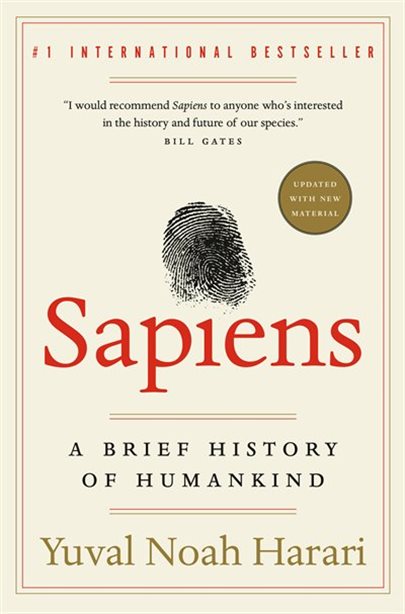
Sapiens - A review by Venkat.


Venkat is very passionate about Sapiens and the ideas from the book, so I requested him to write the review but somehow it was not happening, so I wrote one in the meanwhile, Now he has penned his thoughts and I am glad he did, for this is more than just a review of the book...
Krishna-

Sapiens: A Brief History of Humankind, by Prof. Yuval Noah Harari is one of the most entertaining and informative books that I have read in a long time. This has been recommended by former President Barack Obama, Mark Zuckerberg and Bill Gates among others. This has been translated into multiple languages since 2014 and has been an international bestseller. 

Prof. Harari states – 70,000 years ago, humans developed cognitive ability which bestowed them to think and communicate in abstract terms (ones that defy objective reality). If we were to ask ourselves what set us apart from other animals, this is that moment in our evolutionary path. Animals still completely rely on biology for their evolution – which is painfully slow.

While all other animals still have a limit on their pack – by believing in stories that are fictitious, humans broke that barrier. These fictional stories gave us multiple identities and enabled us to cooperate with complete strangers to achieve our goals. Material needs ensued invention of money, companies myth; need for social order birthed religions-gods myth; these and fortuitous foray into agriculture enabled us to live in few thousands together – from alpha males to tribal chieftains, we moved on to Empires myth which coagulated into nation, country myths, etc.

One of the offshoots of the scientific revolution - project Gutenberg started publishing books which helped successive generations of humans to stand on the shoulders of their forebears and shoot for stars. Consider this for a moment, it just took 60 years since the invention of the airplane for humans to send a man to the moon.

In retrospect, it has been a good ride for humans. Why complain?

The imagined identities that we amassed (which we call growing up) from such fictional stories– is causing more harm by dividing us now into us vs them, good vs evil, what’s true vs what’s not, and worse still, we do not seem to care for truth either. To make matters worse – Silicon Valley social media giants are competing with one another to capture and retain our eyeballs. They are exploiting our vulnerabilities by racing to the bottom of our brain stem through their suggestions for us to read, watch videos, associate oneself with one or another moral group. The result? We now live in balkanized communities with more stark fault lines and conversations between groups is impossible. Technology has been leveraged in the elections last few years world over to manipulate people’s will by pressing our emotional buttons without our knowledge or consent; If this continues – Civilizations and Democracy as we know of, would be a thing of past.

To be fair – humans have always had differences of opinion. But when you combine that with complete communication breakdown with the other side, indulge in name calling, de-humanize people in opposite camps – we have been through those situations in the past and those did not end well.

In a globalized world – we all are more interconnected and interdependent than we believe we are. If we consider every major challenge facing humans now – nature of future job market in the age of AI, impact of climate change, nuclear weapons– all these needs coordinated responses from all countries.

Is there a way out? What could I do as a responsible human? At an individual level – we could spend time and educate ourselves. With so many layers of identities each one of us accumulate as part of growing up – member of a family, company, culture, region, religion, language, country, philosophy, etc. – we need to train ourselves to see and experience reality without any of these imagined identities.

Sapiens could help you get there. If. only. you. want. to.

Venkat-

Monday, February 24, 2020

Pilgrimage Within

Our imagined orders of yesterday
Become our realities of today
As, Our stories of today
become our history for tomorrow

The facades we build
To support our social structures
Become our shackles
That hold us back

The myths we weave
To explain our ignorance,
Become our gospels
That lead us astray

The heroes we create
To overcome our fears,
They become our Gods
Whom we fear now

We become prisoners
Of our thoughts,
As our hopes
Become our dogmas

There is no Saviour coming;
Our salvation will come
When, we question our
Handed down wisdom

There is no Shepherd coming;
We will know our direction
When, in the quest for knowledge
We open our minds

There is no  Charioteer coming;
Our enlightenment will come
When, in search of our true self
We start the Pilgrimage within.

- Krishna
Inspired by "Sapiens: A Brief History of Humankind" by Yuval Noah Harari.

Friday, February 21, 2020

Sapiens - Why humans dominate the Earth?

A meaningful life can be extremely satisfying even in the midst of hardship, whereas a meaningless life is a terrible ordeal no matter how comfortable it is – Yuval Noah Harari

There are some books that make you sit up and do a lot of “deep thinking”, make you question your core beliefs and as a result, possibly alter you as a person. Sapiens: A Brief History of Humankind by Yuval Noah Harari is one of them.

Harari is an Israeli historian and a professor in the Department of History at the Hebrew University of Jerusalem. He is gay, vegan and a practitioner of Vipasana meditation for 20 years (and vocal about all of them). Harari specialized in medieval and military history at the Hebrew University of Jerusalem and has a Doctorate from Oxford. He has many best sellers and articles to his name, Sapiens being the foremost among them. Sapiens was published in Hebrew in 2011, became a national best seller in Israel and was published in English in 2014; it has since been translated into some 50 languages. It made Harari a superstar.

Sapiens is breath-taking in its scope (which is the entire history of our Human race and projections for the future thrown in for a good measure!), Provocative in its assertions, entertaining in its language; this book is surely an unputdownable.  Some of what is written in the book is not new or original, some are wild assertions too, but the extraordinary writing paints a macro view of the different stages of our evolution through our many revolutions makes this book very engaging and important. As you read, you will agree that Harari does have a different way of looking at things e.g., "we did not domesticate wheat. It domesticated us", “Consistency is the playground of dull minds”  (The last one would have been inspired by Oscar Wilde who said “Consistency is the last refuge of the unimaginative” ).

Sapiens is mostly about how we (Humans) came to dominate the Earth - in spite of having many disadvantages and being an “insignificant animal” (sic) and a little about what may lie ahead for us in the years to come. The book traces human history through various human revolutions, It starts with the first, about 70,000 years ago with the cognitive revolution, and then to around 12,000 years ago as the agricultural revolution starts with domestication of plants and animals and start to settle down in colonies; third is the scientific revolution, about 500 years ago that leads to industrial and later information revolution about 50 years ago and then the Biotech revolution – which is just evolving and transforming; probably into bio-engineered cyborgs that could live forever – which in some ways signal the end for Sapiens!

The key change, of course is the start of the cognitive revolution, which set us on a different evolutionary arc. This Cognitive revolution helped us to create stories and imagined realities (myths) like money, country, God (yes, all these are only real because we have collectively chosen to believe so), this enabled us to work in large groups in a flexible, cooperative manner, that in turn enabled us to create economy, empire and religion. This was a game-changer as we out ran (or wiped out) our competitors including our cousins the powerful Neanderthals - who lived until about 40,000 years ago. Much like the network of low powered computers made the mighty standalone mainframes insignificant and eventually obsolete. Long story short; our human domination is the outcome of our cooperation and ability to use tools and technologies and the cooperation is because of our beliefs in common ideological or religious myths.

The future according to Harari, holds dangers and opportunities. From what I read, opportunities for a minority and dangers for the majority, primarily because of the gaps between rich and poor and a huge class of humans who would be rendered useless thru AI. We are seeing both these scenarios are already in play, the divide between poor and rich is wider than ever before – (the Oxfam report states that the wealth gap continued to widen in 2017, with 82% of global wealth generated going to the wealthiest 1%. Another report states that 2,153 billionaires owned as much wealth as the bottom 4.6 billion people in 2019) and more and more workers losing jobs to AI, robotics and automation in general and unable to repurpose themselves (Forrester predicts job losses of 29% by 2030 with only 13% job creation to compensate). Such economic disparity along with job loss is a perfect recipe for political instability and a general moral crisis (Widening income inequality is the defining challenge of our time- 2015 IMF report). History proves that humans have not handled power responsibly, for us the relationship between power and responsibility is inversely proportional.

Harari touches upon various topics across a wide spectrum; globalization, human greed, the definition of happiness; whatever the topic Harari never ceases to surprise with his ability to connect the dots (which at times, does look a little far-fetched) and thus creating an amazing visual of the past and future of mankind. So, as Aristotle said; ‘It is the mark of an educated mind to be able to entertain a thought without accepting it’ or as Venkat says ‘leave your opinions in the parking lot’ and get ready to ‘immerse yourself’ (this is important) and start to question your values, judgements and the opinions that you left behind at the parking lot!


Sapiens is listed as one of 10 favourite books of Bill Gates and is the Gaurdian’s best brainy books of the decade

“You could never convince a monkey to give you a banana by promising him limitless bananas after death in monkey heaven.”
― Yuval Noah Harari, Sapiens: A Brief History of Humankind

Monday, October 28, 2019

How Democracies Die

“The drift into authoritarianism doesn’t always set off alarm bells. Citizens are often slow to realize that their democracy is being dismantled even as it happens before their eyes.”  Steven Levitsky & Daniel Ziblat - How Democracies Die
Today, the slide from democracy to autocracy happens in small increments, over a period of time. Unlike the coup that ends an elected regime abruptly and, in most cases violently; democracies, in the modern political world are killed slowly by the leaders who are elected to protect that very system which they used to get to power in the first place. This, is the premise of the book “How Democracies Die”
Steven Levitsky and Daniel Ziblatt are Harvard University’s political scientists and this book by them comes at a time, when democracies across the world are being threatened by right wing alpha male leaders. The book is a warning, an alarm, to the ascension of demagogues and helps to identify the preceding signs. Although the book focuses on the US (the idea of the book is prompted by the election of Trump) it uses case studies of leaders from other countries including Putin in Russia, Erdoğan in Turkey, Orbán in Hungary and Maduro in Venezuela. Based on these studies, the authors outline four key indicators, or warning signs, of authoritarian behavior that is detrimental to democracy (1) the rejection, in words or action, of the democratic rules of the game, (2) the denial of the legitimacy of political opponents, (3) toleration or encouragement of violence, and (4) a willingness to curtail civil liberties of opponents, including the media. If we consider these key indicators, there is no denying the fact that Democracies across the world are facing existential threats from big, loud mouthed and divisive nationalist leaders.
In addition to the 4 indicators, the authors also identify two crucial informal norms (the unspoken/unwritten rules) as the pillars of democracy (other than the formal institutions and processes), (1) mutual toleration and (2) institutional forbearance. These informal norms are also being undermined in the recent times, when leaders are focusing on their short-term gains as against the long-term benefits for the nation/people they govern.
The book could have had an increased focus on influence of social media in the democratic process. We have seen in the recent elections of US and India that social media has played a significant role in swaying the though process of voters and thereby the votes and results. Social media (ab)use had a similar effect on the Brexit vote too. We also have most of the leaders today communicating through this medium rather than the traditional media. At times it feels like the US is governed through a series of Twitter posts.
The solutions provided in the book are primarily through lessons from history, which may or may not be applicable in today's world. The solutions also sound too idealistic in the current environment. Nevertheless, this is an interesting and important book which has come out at an appropriate time, especially for us. While we are not seeing all the 4 indicators consistently, there surely are green shoots here and there. As for the 2 informal norms (mutual toleration and institutional forbearance), I am sure the evidence is there for everyone to see (esp., if you watch the 9:00 P.M. special debates). The book is even more important now, considering that there is no visible or audible political opposition today in this country – which, for me, is the first sign of the slide in a democracy.

Sunday, September 29, 2019

Life of the Purposefully Unrushed

A Gentleman in Moscow - Amor Towles.

A Gentleman in Moscow is an exquisite tale, that for most parts moves like a stream, at a languid pace and then all of a sudden takes a surprising turn and crashes down with the power and beauty of a mighty falls.

Post the Russian Revolution, Count Alexander Ilyich Rostov is condemned to lifelong house arrest in the majestic Hotel Metropol in Central Moscow by a Bolshevik tribunal. He would be shot if he ever steps out of the hotel. And so the story goes on as Count Rostov moves to a disused servant’s quarters (more of an attic) in the hotel and becomes, from an aristocrat, to a waiter and stays on for 32 years, till he makes a stunning escape.

In those 32 years we travel through the turbulent times of Russia, from the Bolshevik upheaval, to the tyrannical times of Stalin (to think that one of our political leaders is named after this dictator who condemned and killed millions of his own folk!) and to Second World War.

For the generation (at least for Sree and me) who grew up on NCBH (New Century Book House on Mount Road, Chennai, was a beautiful place filled with the fragrance of new books, that had amazing illustrations and top notch print and paper quality), Maxim Gorky’s Mother and the romanticism of communism; would be able to connect, reminisce and eventually be disappointed with the reality of the times gone by (there is a remark on Gorky in the book, which would shake those who revered Gorky and The Mother).

The Novel, is a series of lessons on culture, and Gentlemanness (I know it is not a word, but it does sounds appropriate) during some very difficult times), with references to fine wine, books and music (the three core elements of a good life, wouldn’t you agree?). The book is a discourse on moral discipline, but done with a light humor and charm that it hardly sounds preachy at any time (also, there is an awesome reference to Casablanca that is beautifully appropriate).
Narrated in third person, you become a part of the ensemble and grow alongside the characters. Some of them so wonderful, you make friends with them, you hate- just the one character and surely will fall in love with a few.

This is just the second novel for American author Amor Towles ( the first being Rules of Civility, also a best seller). Towles, left behind a successful investment profession of 22 years to become a successful novelist. It took more than 3 years for Towles to finish The Gentleman in Moscow and every page is a testament to that spectacular effort.

Quotes from the book, that I liked most:
  • If a man does not master his circumstances then he is bound to be mastered by them.
  • What matters in life is not whether we receive a round of applause; what matters is whether we have the courage to venture forth despite the uncertainty of acclaim.
  • If patience wasn’t so easily tested, then it would hardly be a virtue
  • To what end, he wondered, had the Divine created the stars in heaven to fill a man with feelings of inspiration one day and insignificance the next?
  •  Life does not proceed by leaps and bounds. It unfolds. At any given moment, it is the manifestation of a thousand transitions. Our faculties wax and wane, our experiences accumulate and our opinions evolve--if not glacially, then at least gradually. Such that the events of an average day are as likely to transform who we are as a pinch of pepper is to transform a stew.

Sunday, September 02, 2012

Bombay Jayashri

I have no Music knowledge. Can't identify the Ragas like Venkat and don't know the difference between the thalams. In fact there is a complete ban on my singing at home, apparently my singing does not sit in sur(am), don't know what that means either!

But, what I know is that I Love Music, almost of all kinds (except Rap and the technosounds that are unfortunately being bandied as Music). Like most of you, some song keeps going on inside my head all the time.

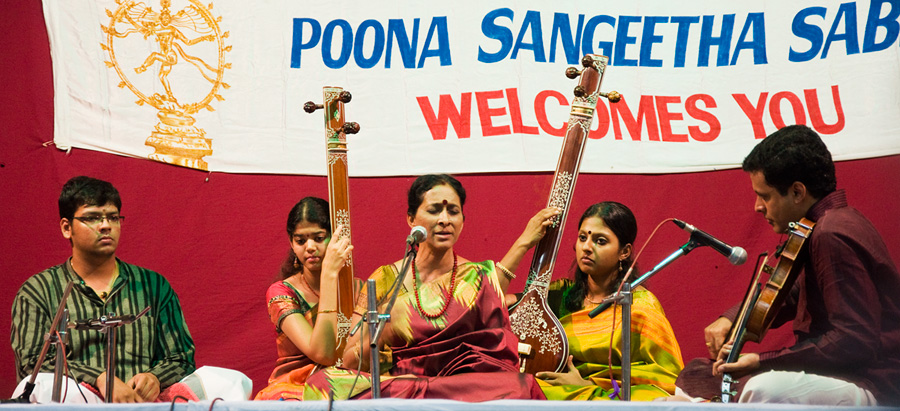
Bombay Jayashri is one of my favorite singers, I have tons of her songs (thanks to Visu for some of those CDs) and she keeps us company when we have this torturous travel to and from office, fidgeting inside the metal cage. I simple love her dark and husky voice, which is very different from most of the classical singers (which is fairly exploited by Harris Jayaraj and co). At the same time she easily scales those highs too, with the clarity and crispness of the winter breeze. There is a soothing, soul stirring quality to her voice. Listen to her sing Ehi Murare or Katyayini and you will understand what I mean (btw, the complete Salokyam album is outstanding and so meditative).

So, when my friend Prashant informed about a Bombay Jayashri concert and offered the tickets, I was ecstatic, to put it mildly.

We left early to hold on to the best seats, up close and bang in front. I could literally see the whites of the artists' eyes. The hall was very basic, but it did not seem to bother the singer or the fans. The program was scheduled to start at 5:15 and it did start precisely at 5:15 and for the next 3 hours we (the Rasikas!) were transported to a different world. A magical world that was full of joy, spirituality and wholesome goodness. During the entire duration, she did not say a word (except for some polite conversations with the accompanying musicians); she did not pause to take a sip of water. She just came, sang, conquered and left.

Pictures here are some that I managed to sneak during the program - the light was not very good and I was nervous, to be sitting just in front and shooting with a camera (even if I was really careful not to disturb).


Saturday, February 18, 2012

The Fight


There is savagery
in their bloodshot eyes.
Dilated to see it all,
In those eyes you search for fear.

They go around each other
One waiting for the other.
Waiting to kill,
It’s a fight to finish.

As the volcano erupts,
You see blood on their hands.
Is it the other man’s blood?
Or, his own? You’ll never know.

This urge to succeed
The lust for power
The power that grabs you
Like quick sand.

It’s a search of glory
The glory that’s brought by gory.
This is a battlefield
We mindlessly walk through.

We prepare
To give everything
Including our last breath
For that gloomy Nothing.

Sitting around in the arena
With great delight
We watch, as the Romans did.
We haven’t changed much.

The cry of the dying man
Suppressed by the howl of the survivor.
Sounds stained by blood.
This is our history.

He now waits to take another
And so it goes on
Until everyone is taken,
And till the last one falls.

Friday, October 28, 2011

Jagjit Singh

I had a great collection of Jagjit Singh's ghazals during my college years and used to hear his songs regularly. Especially, on the morning of an exam day, I would have his songs plugged on to my ears (good old sharp walk man - with auto reverse!). His voice had a soothing effect and I found/find it very meditative. A percentage of my good(!) final year marks can be attributed to Jagjit Singh.

His voice is so heavy and beautiful, just listen to this later day beauty from Sarfarosh… http://www.youtube.com/watch?v=JAh4bqBUGkY (even if you don’t understand the meaning it is fine. May I suggest that you get, if possible, a CD or the mp3 and listen in a good system with the volume a bit higher than normal to feel the heaviness of his voice, the humming portions are so magical.

The lyrics… most of the ghazals are in urdu and are inherently beautiful. This song in Sarfarosh talks about the magic of love and goes something like this (to the best of my borrowed knowledge):

Hoshwalon Ko Khabar Kya
Bekhudi Kya Cheez Hai
Ishq Ki Jaye Phir Samajhiye
Zindagi Kya Cheez Hai


Person who is in his full sense will never know
how it feels to lose oneself (to love).
Fall in love and you will understand
What life is all about.

Irshaad comments that most of the Ghazals are about love or wine... It is true, while most of the songs are about the Nasha of Love or wine (they sure know what to celebrate), many songs are quite philosophical and about some fundamental questions too.

Jagjit Singh passed away this October 10th.

Saturday, July 09, 2011

The Palace of Illusions

The Palace of Illusions is Mahabharata told from Draupadi's perspective; she is the Protagonist. Given this premise and given that the Mahabharata is the most complex story ever told (wiki: With about one hundred thousand verses, long prose passages, or about 1.8 million words in total, the Mahabharata is roughly ten times the length of the Iliad and Odyssey combined, or about four times the length of the Ramayana), this could have been a magnum opus by Chitra Banerjee Divakaruni (CBD). Unfortunately CBD falters after a great start.

The initial phase of Draupadi's tale, her interactions with her brother Diru and friend Krishna, are told with great sensitivity and style. As Draupadi grows up and gets married, she sounds more and more like an ordinary human (with 5 husbands, of course). Much worse is that Draupadi keeps cribbing (I agree that she had many reasons to crib) and page after page yearns for the forbidden love of Karna. Although these feelings towards Karna (and vice versa) are hinted in other versions of the Mahabharata; the palace of illusions talks about it in almost every page, which kind of gets annoying – ‘for heaven's sake, the human race as we know is getting erased and millions are getting killed in the great war and here we are crying over love’, is what you want to say.

The other disappointment is the characterization of Kunti and Yudhisthir; both are portrayed as one-dimensional cardboard characters and in fact Draupadi treats them with disdain throughout. There is a bit of remorse in the end, but that is probably too little too late. The mother in law - daughter in law interactions between Draupadi and Kunti are so clichéd and you wonder, if the author wants to portray Draupadi as a stong and extraordinary women, born to rewrite history, then why does Draupadi get into these petty trappings?

The good aspects are: the book keeps a good pace, the narrative is easy and does not have the usual complications of a tale of this complexity (probably because the book is targeted at the western reader, CBD lives in the US), yet it covers most of the critical happenings of Mahabharata - with a few liberties taken here and there, like the two marriages and nine sons of Karna are never revealed, probably to keep the romantic angle alive.

For me, the highlight of the book is the Krishna - Draupadi relationship, it touches a few philosophical notes of man-god relationship.
Sample this:
When asked by Draupadi: "Can't you ever be serious?' Krishna replies: 'It's difficult, there's so little in life that's worth it’.
In the end when Draupadi is about to die, Krishna explains the futility of her remorse and tells her that she is just an instrument, this is probably taken from the essence of the Gita itself, but it is a good discussion.

If there is a God, I wish he is like Krishna, ever playful, ever intriguing, great philosopher and charioteer for the righteous (and in the process bends the rules here and there).

Saturday, June 25, 2011

Wisdom Paradox

This post was trigged by a coincidence; I got a mail from Venkat about this blog while I was reading ‘The Wisdom Paradox’ by Elkhonon Goldberg; the coincidence is that the blog and book are on a similar theme – Dementia or the atrophy of the brain. It is a known fact that our brain atrophies as we age and eventually most of us will lose some and an unfortunate few will lose most of our cognitive abilities. This topic is of great interest to me since I have recently crossed the milestone 4 decades of existence and every now and then I worry about the possibility of me spending the last years of my existence wearing a bib and trying to recollect what I did a minute ago!

The book; The Wisdom Paradox is a paradox in the sense that it gives you hope and at the same time it reconfirms your fears about aging too. The bad news first -after the initial stages of development and maturity (till your thirties) our brain starts to degenerate, starting with the newly evolved neocortex that make us who we are, humans (neocortex controls the working memory, speech and language) and the right hemisphere deteriorates more than the left. So you will have issues with new learning, analytical ability and creativity. Your ability to learn new languages will be affected too (there goes my goal of learning French this year).

The good news is that what you lose in creativity and novelty you gain in wisdom. Wisdom is an acquired response to recognized patterns. So during the early stages of our life we assimilate new information and develop neural patterns. As we age, the brain begins to atrophy, losing about 2% of its size per decade, but we reach insightful conclusions intuitively based on the lifelong collection of the neural patterns. This, you see, is the strength of leadership. The experience accrued over a lifetime being used in decision making, esp in abstract situations – like running a nation or an organization.

The point to reflect is that this wisdom can’t dawn overnight when we become old, we need to collect various experiences in our early stages of life and build the neural patterns that would help in achieving this wisdom, even when as we lose our analytical and learning abilities. So, spend your early years hunting for knowledge (like reading this blog :)) that can be turned into wisdom later.

The Blog; I believe that the overall, degeneration (cells dying as we age) would be of little consequence – so it does not matter that, ‘You had more brain cells the day you were born than you’ll ever have again’. You definitely had less brains when you were born than you’ll ever have. Also, it is very complex, elephants have double the neurons as humans, and if you are talking about the brain to body ratio, then birds have a better ratio… I am sure you will agree that we have better cognitive capabilities compared to elephants and birds (of course, can’t say that for everyone I work with). So, it is difficult to say why you will lose your mind -whenever that happens; but you can be sure that it is just not because of reduced cells. It is worthwhile to note that research has not established the reason or medication for, say, Alzheimer more than 100 years since Dr. Alzheimer described it first. So I find this article to be assuming too many things and making it simplistic. It is possible that dementia is more of genetic in nature and probably has no cure or prevention. And your cognitive skills at the ninth decade would probably be thanks to the strong genes provided by your parents (and generations before them).

I agree that the brain needs constant stimulation (not the one provided by TV) that allows the neurons to form new connections. We should constantly try to learn new skills, improve your social interactions and broaden our knowledge (browsing the net does not count) and ponder about them (hence, having a mid-life crisis is probably a good thing for your brain).

Yes, every time I search for that wretched remote or the car keys; I am worried that very soon I may forget my own name, I am still not sure how to avoid it completely – let me try Sudoku or Rubik’s Cube or learn to draw and paint.

Sunday, December 12, 2010

RX100

"The real cycle you're working on is a cycle called yourself."

"In a car you're always in a compartment, and because you're used to it you don't realize that through that car window everything you see is just more TV. You're a passive observer and it is all moving by you boringly in a frame.

On a cycle the frame is gone. You're completely in contact with it all. You're in the scene, not just watching it anymore, and the sense of presence is overwhelming."

— Robert M. Pirsig (Zen and the Art of Motorcycle Maintenance: An Inquiry Into Values)

When you move around in a car with all the windows closed, there are only 2 vehicle exhaust sounds that you would distinctly hear inside the cabin -one is, of course, the Bullet and the other is a Yamaha RX100. The sound is so apparent that my normally vehicle/gadget illiterate dear wife would stir and ask me, ‘That is a Yamaha, right?’ of course she is right (isn’t she always right?), for the heartbeat of an RX100 is very hard to miss. Whenever I hear that sound, I immediately go back by some 20 years, when I had the pleasure of driving around my very own RX100 -a black RX100 (I had to choose and would not take any other bike or any other color).

The day I took my RX100 to college, I became ‘somebody’. Guys I have never known before wanted to be friends with me; I became a sort of mini celebrity (yes, I am exaggerating a bit, but not much). But, one still has to capitalize on this newly acquired status, and I realized this couple of years later when a colleague, exclaimed, “I never thought YOU will be driving THIS!!!” A good way of thanking someone who offered a lift, in the middle of the night!

I took great pride and took great care of my RX100. Used to wash it and shine the chrome every day. Will be tuning and adjusting the idling or scraping the carbon off the spark plug. If I had to sit somewhere I would normally put my bike on centre-stand and sit on my Rx100. I took it to the best mechanic in town, who specializes in Yamaha and also someone who loves bikes (the second attribute was every important). Today, I sometimes wonder where that passion has gone; it is true that I am quite detached when it comes to my car and view it as just a mode of transportation. I am reminded of the quote I read somewhere, “Four wheels move the body. Two wheels move the soul”; that probably explains!

Recently I had the opportunity to drive my old RX100 (I can’t say ‘my’ as it is currently owned by a cousin, who was kind enough to let me drive for a while – of course with a thumping heart I am sure), the old bugger was as good as it was 20 years ago. Obviously between the two of us the RX100 had aged more gracefully! They don’t make bikes like this anymore!

There are many memories associated with this bike (with great reluctance I call it with a lack of identity –Bike). I vividly remember the day I took my wife (then fiancée) out for the first time and it was on this very vahana. We went around from Nungambakkam to Greams Road and the bends around the crooked College Road is still fresh in our collective memory.

A quick anecdote to end this blog; one of those days when zipping down the Bannerghatta road at Blore, my best friend (Happy Birthday, Irshaad ) was sitting behind, tears streaming, he hollered, “I don’t know how you are driving, I can hardly open my eyes!”, and I hollered back, “close them, just as I have closed mine!!!”....

Cheers to those many rides.

Arrivals and Departures